
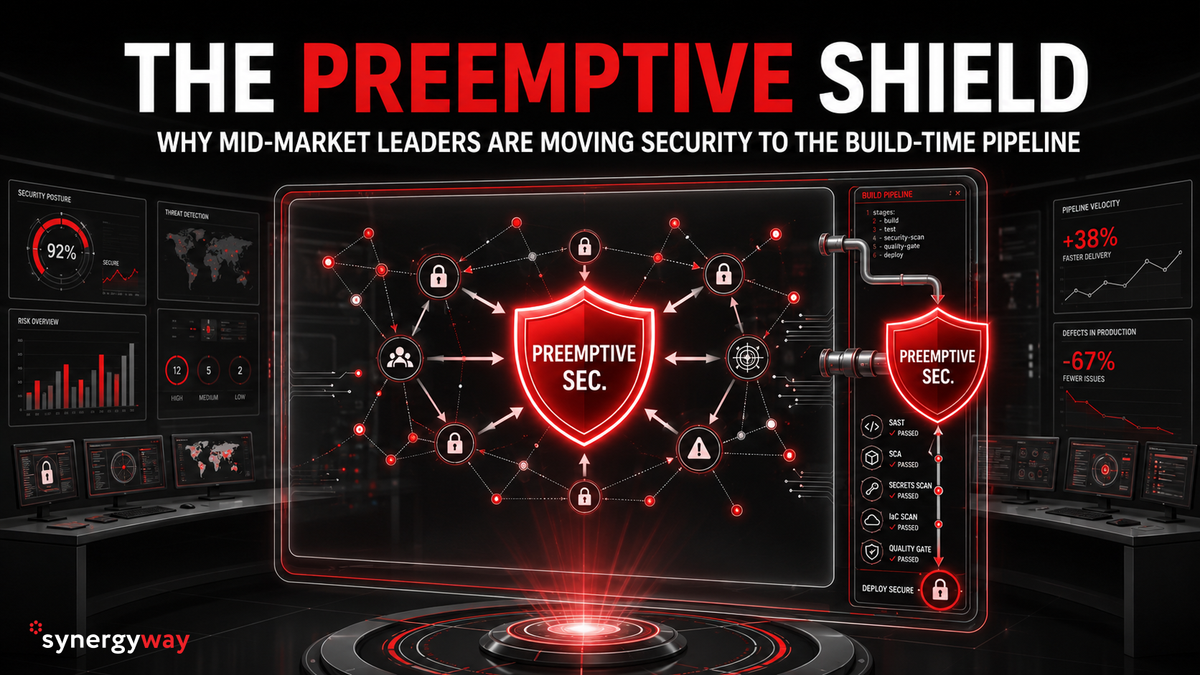
The global business environment of 2026 has reached a turning point in digital security. For years, organizations relied on a reactive “detect-and-respond” model, treating cybersecurity as a defensive shield that activated only after an incident. Today, as threat actors weaponize generative AI, cloud automation, and sophisticated scanning tools to exploit software vulnerabilities within minutes of exposure, that reactive approach has become a critical business liability.
For mid-market IT and business leaders, security is no longer an isolated technical checklist; it is a core management issue that directly influences business continuity, operational agility, and enterprise value. To adapt, forward-thinking enterprises are shifting their posture leftward—embedding defense directly into the software development lifecycle (SDLC) and build-time pipeline.
1. The Death of Reactive Security
For over a decade, mid-size organizations operated under a static security paradigm: build software rapidly, deploy it to production, then hire an external vendor to run a penetration test or vulnerability scan once or twice a year. In 2026, this point-in-time approach is structurally obsolete.
The AI-Accelerated Threat Matrix
The primary catalyst for this shift is the role of artificial intelligence in offensive cyber operations. Threat actors now use automated AI frameworks to conduct continuous reconnaissance and infrastructure preparation at machine speed. When a new zero-day vulnerability or misconfiguration is disclosed, malicious scripts can identify, target, and exploit vulnerable, internet-facing assets globally in minutes.
Because human analysts cannot investigate and react at machine speed, any security model that relies on manual triage after an alert is generated is fundamentally mismatched to the threat.
The Shift to Preemptive Cybersecurity
Recognizing this operational gap, Gartner has formalized Preemptive Cybersecurity as a primary strategic technology trend for 2026. Preemptive cybersecurity is an anticipatory defense posture designed to predict, disrupt, and neutralize potential threats before adversaries can reach production systems or complete an attack chain.
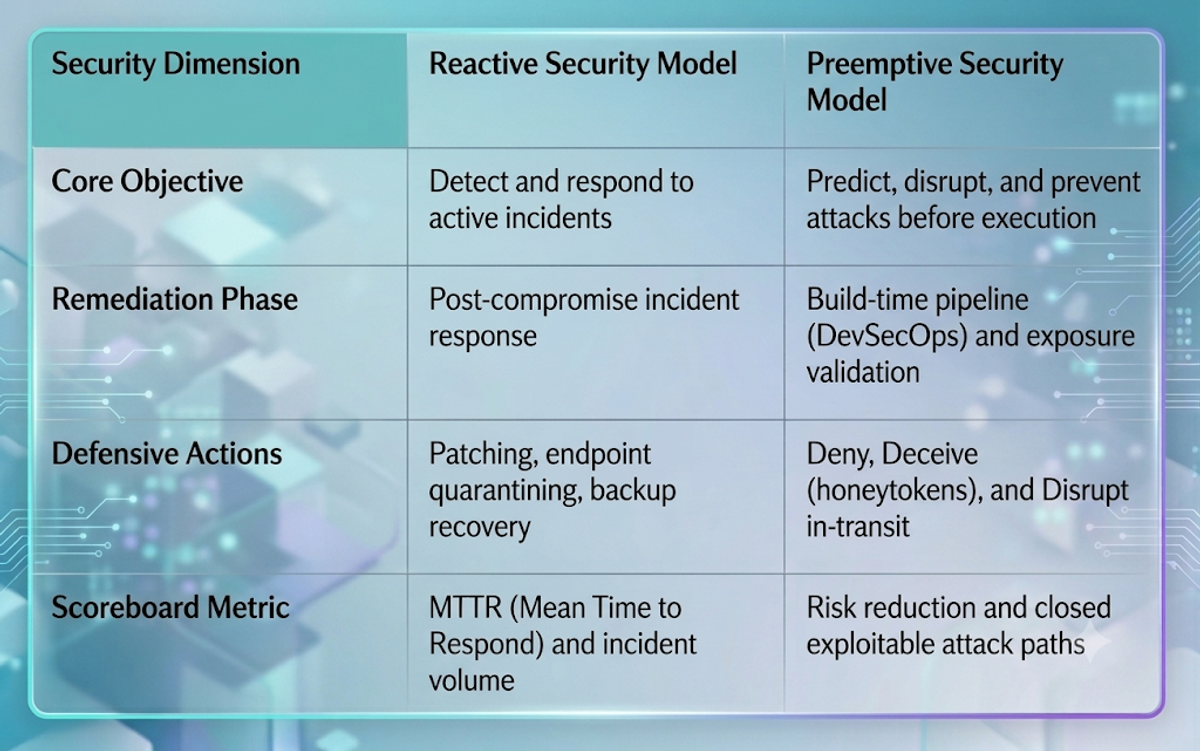
High-stakes industries like banking, healthcare, and government are leading adoption of this paradigm. Gartner projects that preemptive cybersecurity solutions will grow from under 5% of IT security spending in 2024 to 50% by 2030, warning that security products lacking preemptive capabilities will lose market relevance entirely by 2028.
2. The Economics of Build-Time Security (Remediation ROI)
The transition to preemptive, build-time security is driven as much by financial survival as by technical necessity.
The Financial Reality of a Breach
According to IBM’s 2025 Cost of a Data Breach Report, the global average cost of a data breach stands at $4.44 million. For mid-size companies, a breach of this scale can be catastrophic. However, the data also reveals a clear path to mitigation: organizations that extensively integrate security AI and automated controls save an average of $1.9 million per breach and resolve incidents 80 days faster.
The “Speed vs. Risk” Tradeoff
Despite these incentives, mid-market development teams face intense operational pressure. Statistically, DevOps and rapid development methodologies enable up to 60% faster releases. This pressure to ship quickly leads to a dangerous compromise: 81% of organizations admit to knowingly shipping vulnerable code under deadline pressure.
When security reviews are treated as a final pre-launch checklist, they become a bottleneck. To meet launch dates, security gates are bypassed, creating “security debt”—accumulated vulnerabilities that currently affect 50% of all organizations.
3. Shifting Left: The Architecture of DevSecOps
To achieve build-time security, organizations must transition from traditional DevOps to a mature DevSecOps model. The global DevSecOps market is expanding rapidly, projected to grow from $11.72 billion in 2026 to $37.32 billion by 2035. This growth is heavily concentrated, with 48% of the market driven by cloud-native application needs and 28% by secure CI/CD automation.
Establishing Mature Security Gates
However, simply running automated security scanners is not the same as having a mature security program. A mature build-time security framework requires integrating six core platformized controls directly into the Continuous Integration and Continuous Deployment (CI/CD) pipeline:
- Secrets Detection: Automatically scanning code commits to block the accidental exposure of API keys, database credentials, or private certificates before they reach version control.
- Software Composition Analysis (SCA): Continuously checking third-party and open-source libraries for known vulnerabilities. This is a critical defensive point: 97% of modern commercial codebases contain open-source components, and over 70% of accumulated security debt originates from third-party library flaws.
- Software Bill of Materials (SBOM) Generation: Automatically producing a machine-readable inventory of every library, dependency, and software component used in the build, protecting the software supply chain.
- Static Application Security Testing (SAST): Scanning the application’s source code for logical flaws, injection vulnerabilities, and architectural weaknesses before compiling.
- Infrastructure-as-Code (IaC) and IAM Policy Checks: Validating configuration scripts (like Terraform) and Identity and Access Management policies to prevent cloud misconfigurations before provisioning infrastructure.
- Immutable Release Evidence: Digitally signing software artifacts and logging change records to provide transparent, auditable proof of who approved the code, which security checks passed, and why it was released.
4. The Modern Frontier: Securing Custom AI and LLM Architectures
As mid-size organizations shift from basic digital workflows to custom Large Language Models (LLMs) and Multiagent Systems (MAS), they face new, non-deterministic security challenges.
Multiagent architectures involve independent, specialized AI agents collaborating to automate complex operational workflows. Because these agents can dynamically invoke tools, call external APIs, and edit databases, they possess significant “agency.” This makes securing the AI integration layer a critical build-time priority.
Navigating the OWASP Top 10 for LLM Applications
Traditional firewalls and web application security layers cannot parse natural language inputs designed to alter an LLM’s logical behavior. To protect these systems, developers must build defense-in-depth mechanisms based on the OWASP Top 10 for LLM Applications:
- Prompt Injection (LLM01): Malicious inputs designed to override the model’s system instructions. This includes indirect prompt injection, where an attacker embeds hidden commands within a PDF, document, or webpage that the model is tasked with processing or summarizing.
- Sensitive Information Disclosure (LLM02): The risk of an LLM inadvertently revealing proprietary algorithms, system prompts, API keys, or confidential customer data (PII) in its natural language outputs.
- Excessive Agency (LLM06): Granting an autonomous AI agent broad permissions, high-privileged system identities, or excessive functionality without hard-coded verification gates. If a model with excessive agency falls victim to prompt injection, it could delete critical databases or initiate unauthorized financial transactions.
To mitigate these risks, organizations are deploying AI Security Platforms to centralize visibility, enforce access boundaries, restrict agents to operating within the user’s specific security context, and monitor model behaviors continuously.
5. Preemptive Exposure Management: Thinking Like an Attacker
While build-time DevSecOps protects the application’s codebase, organizations must also defend active, running infrastructure. Traditional external security measures are failing due to a severe operational bottleneck: alert fatigue. Security teams are routinely overwhelmed by scanning tools that dump thousands of raw, undifferentiated vulnerability alerts with no context about actual exploitability.
Bridging the Detection-to-Prevention Gap
Preemptive Exposure Management resolves this crisis by shifting the focus from theoretical vulnerabilities to validated risk. It continuously answers a different operational question: “What is exposed on our perimeter, what is actually exploitable by a real attacker right now, and what must we remediate first?”.
This modern architecture unifies two core capabilities into a single, continuous workflow:
- Preemptive Exposure Assessment (PEA): Continuous discovery and mapping of an organization’s entire external attack surface from an attacker’s perspective—identifying shadow IT, forgotten subdomains, exposed APIs, and “shadow AI” instances.
- Preemptive Exposure Validation (PEV): Automated, continuous adversarial validation and penetration testing to confirm whether a discovered vulnerability can actually be executed or chained together by a real-world threat actor.
By focusing on the early reconnaissance and resource-development phases of the MITRE ATT&CK framework, preemptive exposure management stops attacks before they ever execute.
At the network layer, this is enforced through the “3 D’s” of preemptive defense:
- Deny: Blocking connections to known malicious infrastructure and closing exposed subdomains at the transit layer, long before payloads can reach endpoints.
- Deceive: Deploying deceptive resources—such as decoy servers, honeytokens, and simulated databases (e.g., Deception360)—within the environment to misdirect and analyze attackers without disrupting operations.
- Disrupt: Fusing predictive threat intelligence and behavior analysis to automatically isolate and block active command-and-control (C2) pathways in real time.
6. Partnering for Preemptive Resilience with Synergy-Way
Building a secure, highly resilient software product in 2026 requires more than code; it requires a disciplined, preemptive engineering culture. For mid-market companies and fast-scaling startups, maintaining dedicated, internal DevSecOps teams and complex exposure validation platforms is operationally and financially out of reach.
At Synergy-Way, we build security into the foundation of every line of code we write. As a senior-heavy boutique development partner, we ensure your product inherits institutional-grade security from day one:
- Secure-by-Design Engineering: We implement automated DevSecOps pipelines containing SAST, secrets detection, and Software Composition Analysis (SCA) as a standard engineering capability.
- AI and LLM Governance: We architect custom AI integrations and Multiagent Systems with strict data sanitization, secure vector boundaries, and sandboxed runtimes to insulate your business from LLM security risks.
- Zero-Trust Compliance: We ensure your application is natively prepared for zero-trust security architectures, robust compliance (SOC 2, GDPR, HIPAA), and seamless interoperability.
Don’t let your next digital product launch become a security liability. Contact Synergy-Way today to schedule a Preemptive Architecture Review or to plan your next secure custom software build.