
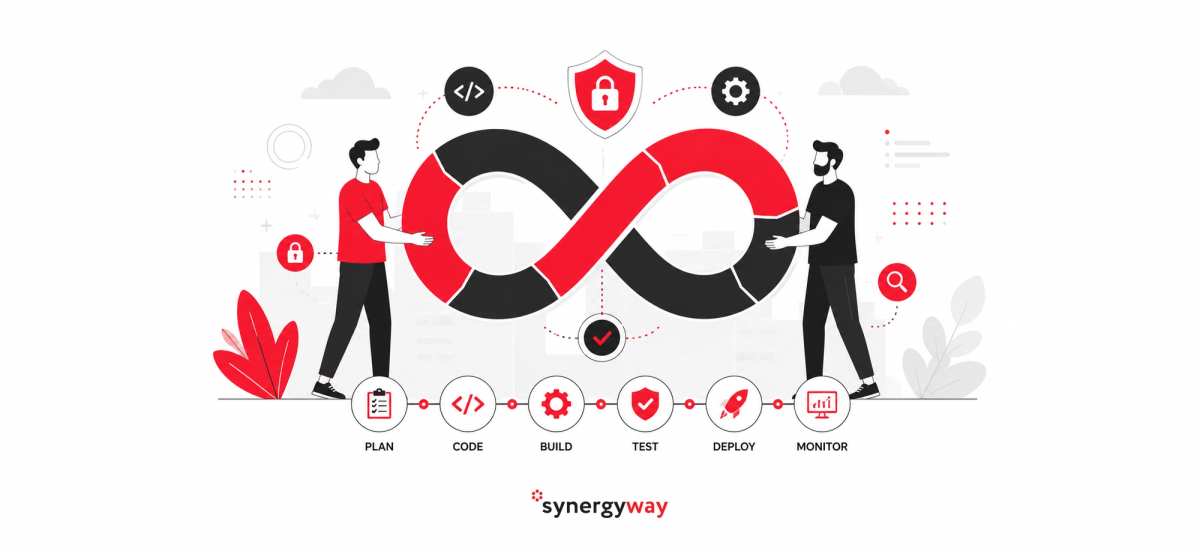
In today’s software economy, speed is strategy. Teams that ship more frequently learn faster, fix faster, and win market share—until security becomes the last-minute tax that slows everything down.
The problem isn’t that security matters less. It’s that the old model—build first, “secure” later—doesn’t scale when release cycles move from quarterly to daily. The path forward for modern engineering organizations is increasingly clear: treat security like any other automated quality signal in the CI/CD pipeline. In other words, turn security from a meeting into a gate.
That shift is at the heart of DevSecOps, a market projected to keep expanding as cloud-native architectures, supply-chain risks, and compliance requirements converge. But for most mid-size companies and scaling startups, “doing DevSecOps” still feels abstract.
Here’s the practical translation: embed automated security controls directly into the moments where code changes—commit, pull request, build, deploy—so developers get feedback when it’s cheapest to act, and security teams stop playing catch-up.
Why “Security At The End” Keeps Failing
For years, many product teams followed a predictable rhythm:
- Design and build.
- QA and performance testing.
- Right before release, run a security assessment.
When security arrives late, it often arrives as a list: dozens or hundreds of findings with limited context, unclear exploitability and no clear owner. Developers face a brutal trade-off: delay the release, or ship with known risk.
That reactive pattern creates three compounding costs:
- Deadline-driven risk acceptance. Under pressure, teams normalize exceptions and push vulnerable code forward.
- Security debt that grows quietly. Unpatched issues linger release after release—especially in third-party dependencies.
- Exponential remediation cost. Fixing an architectural flaw after launch can be orders of magnitude more expensive than catching it during design.
The better model is to move detection earlier and make it automatic. This is the “shift left” idea—but done well, it isn’t about adding more tools. It’s about building a pipeline that makes the secure path the default path.
What A “Security Gate” Actually Means In CI/CD
A security gate is a decision point in your delivery workflow where code cannot progress unless it meets pre-defined security criteria.
Just like unit tests can block a build when coverage drops, security gates block when risk crosses a threshold—typically based on severity, exploitability, exposure or policy.
Two principles separate high-performing DevSecOps programs from noisy ones:
- Progressive testing. Run quick, high-signal checks early (commit/PR), and deeper checks later (build/release).
- Actionable outcomes. Every failed gate should tell a developer exactly what to do next—not just what’s wrong.
The Six Controls Mature Pipelines Standardize On
Most resilient CI/CD security programs can be reduced to a small set of automated controls. The tools vary, but the categories don’t.
1. Secrets Detection
What it does: Scans code for hardcoded credentials—API keys, passwords, tokens—before they reach shared repos.
Why it matters now: Credential exposure remains one of the fastest paths to breach. A single leaked cloud key can bypass every perimeter control you’ve invested in.
Implementation tip: Run lightweight secrets scanning locally (pre-commit) and again in pull requests. Add automatic revocation playbooks for common providers where possible.
2. SCA (Software Composition Analysis)
What it does: Detects known vulnerabilities (CVEs) and license risks in third‑party dependencies.
Why it matters now: Modern applications are largely assembled, not authored. Attackers know that poisoning the dependency graph is often easier than attacking your bespoke code.
Implementation tip: Don’t just alert. Enforce policies: block new critical vulnerabilities; allow time-bound exceptions; auto-open upgrade PRs.
3. SBOM Generation
What it does: Produces a Software Bill of Materials—an inventory of components and versions shipped with a build.
Why it matters now: Enterprises and regulators increasingly expect traceability. When the next high-profile library vulnerability hits, the question won’t be “Are you affected?” but “Prove you’re not.”
Implementation tip: Generate SBOMs per build and store them alongside release artifacts. If you can, sign them cryptographically to support attestation.
4. SAST (Static Application Security Testing)
What it does: Analyzes source code for risky patterns—like injection flaws, insecure cryptography usage, path traversal and more—without requiring runtime execution.
Why it matters now: SAST is one of the few ways to catch entire classes of defects before code ever deploys.
Implementation tip: Prioritize tools that reduce noise (deduplication, data-flow awareness, exploitability scoring) and integrate directly into PR reviews.
5. IaC And IAM Scanning
What it does: Checks Terraform, CloudFormation and Kubernetes configs (plus IAM policies) for misconfigurations—public storage, overly broad permissions, insecure network exposure.
Why it matters now: Many breaches are configuration mistakes, not “hacks.” Infrastructure is code, so it needs the same automated controls as application code.
Implementation tip: Treat cloud policy as a product. Maintain versioned guardrails (policy-as-code) and enforce them in the pipeline before provisioning.
6. Release Evidence (Attestation And Audit Trails)
What it does: Produces a verifiable record of what shipped, who approved it, which tests ran and what the results were.
Why it matters now: Compliance audits and customer security reviews are increasingly about evidence. Teams that can’t produce it quickly lose time—and sometimes deals.
Implementation tip: Automate evidence collection and make it immutable. If your process depends on screenshots or manual spreadsheets, it’s already broken.
The Polyglot Monorepo Problem (And Why It Breaks Naive Scanning)
As organizations scale, they often consolidate into polyglot monorepos—single repos that contain multiple services and languages: TypeScript frontends, Go APIs, Python jobs, Terraform, Kubernetes manifests, and more.
Monorepos can improve collaboration and consistency. But they also magnify security pipeline pain:
- Pipeline bloat. Running deep scans across millions of lines of code on every commit can make CI unusably slow.
- Alert overload. Findings arrive in separate tool dashboards, with duplicated issues and unclear ownership.
The solution isn’t to abandon scanning. It’s to modernize how scanning is executed and triaged.
What to look for in tools and workflow
For monorepos, maturity tends to hinge on two capabilities:
- Incremental scanning: scan only what changed and what it affects.
- Developer-centric prioritization: group related findings, surface the “fix first” items, and suppress non-exploitable noise.
Examples of approaches teams use
Different organizations land in different places depending on size, compliance pressure and security staffing:
- Unified platforms that combine secrets, SCA and SAST under one policy engine—often preferred by mid-market teams that want speed and simplicity.
- PR-optimized scanning that provides fast feedback without requiring full builds, aimed at minimizing friction for developers.
- Open-source engines that allow custom rules and deep control—useful for security teams with strong internal expertise.
- Orchestration layers that run multiple analyzers and normalize output, reducing dashboard sprawl.
The key is not the logo. It’s whether the toolchain can deliver high-signal feedback quickly enough that developers actually act on it.
What “Zero-Friction DevSecOps” Looks Like In Practice
Automation alone doesn’t create maturity. Mature programs design security for the way developers work.
That typically includes:
- Secure defaults. New services start with a hardened CI template, baseline policies and required checks—no manual setup.
- Context in the workflow. Findings live where work happens: pull requests, issue trackers and IDEs—along with clear remediation guidance.
- Smart gating. Not every warning is a release blocker. Mature pipelines differentiate: a low-risk advisory might create a ticket; a leaked secret stops the build.
- Supply-chain integrity. SBOMs, provenance, signing and dependency policies work together to reduce exposure to upstream compromise.
The Bottom Line
Shipping fast and shipping securely are no longer competing goals—if security is engineered into the pipeline as an automated, progressive set of gates.
For leaders, the question to ask isn’t “Do we have security tools?” It’s “Do our delivery workflows make the secure choice the easy choice—and can we prove it when customers and auditors ask?”
If the answer is no, the opportunity isn’t to buy one more scanner. It’s about designing a pipeline where security becomes just another reliable signal—one that accelerates releases rather than delays them.
Build a Resilient Digital Product
In today’s software economy, shipping faster can’t come with hidden risk. If security vulnerabilities and slow compliance evidence are delaying your roadmap, Synergy-Way helps you turn security into automated, dependable CI/CD gates.
Contact Synergy-Way Today and get a free pipeline audit and learn how we can help secure your upcoming software launch.