
Mid-sized companies face a difficult modernization decision. Their legacy systems are becoming harder to maintain, integrate, and secure—but replacing them completely may introduce more cost, disruption, and delivery risk than the business can absorb.
The challenge is compounded by limited access to experienced cloud, platform, and modernization engineers. Internal teams are often expected to maintain critical systems, deliver new features, and learn a new architecture simultaneously.
For many business-critical systems, the safer option is incremental modernization: improving the capabilities that constrain the business first, while the existing platform continues to operate. Techniques such as the Strangler Fig pattern can reduce cutover risk, create earlier opportunities for measurable value, and give the internal team time to build practical ownership of the modernized platform.
The objective is not to replace old technology for its own sake. It is to modernize the right capabilities, in the right order, without losing the business logic that keeps the company running.
Table of Contents
- Why Complete Rebuilds Become High-Risk
- How Incremental Modernization Works
- Closing the Skills Gap Through Co-Engineering
- The Business Case: Control, Continuity, and Earlier Value
- Signs Your Legacy System Is Ready for an Assessment
- How Synergy-Way De-Risks Legacy Modernization
1. Why Complete Rebuilds Become High-Risk
The appeal of a complete “rip-and-replace” is understandable. Engineering teams gain a clean technical foundation, while leadership gains the promise of a modern, cloud-ready platform. In practice, however, a ground-up rewrite can become one of the organization’s most demanding technology initiatives.
Three structural challenges frequently create trouble:
- Hidden business logic: A mature system may contain years of undocumented edge cases, regulatory requirements, customer-specific behavior, and operational workarounds. A rewrite can miss these details, causing functional regressions or disruption when the new system is introduced.
- Moving requirements: Large rewrites can take years. During that period, customer expectations, market conditions, regulations, and internal priorities continue to change. The replacement platform may be solving an outdated version of the problem by the time it is ready.
- Competing costs: The organization must fund the new platform while continuing to maintain the existing one. If delivery slips, the period of duplicate cost and operational strain becomes longer.
A full replacement can still be justified when the current platform cannot meet critical security, regulatory, performance, or strategic requirements. The decision should follow an assessment of the architecture and business capabilities—not a general preference for starting over.
2. How Incremental Modernization Works
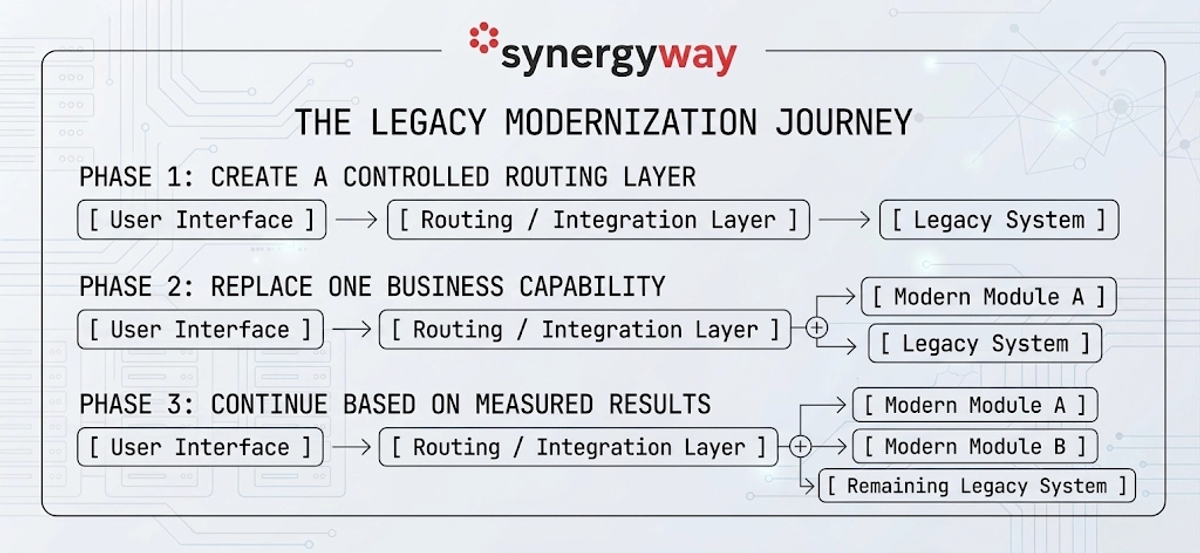
Incremental modernization replaces selected capabilities while the existing system remains operational. One established technique is the Strangler Fig pattern, named by software architect Martin Fowler after vines that gradually grow around and replace a host tree.
A routing or integration layer is introduced between users and the existing application. New services or modules are then built alongside the legacy system and receive traffic only for the capabilities they replace.
Selecting the Right Starting Point
The first module should not simply be the oldest or most frustrating code. A strong candidate is:
- Valuable to customers, employees, or business operations.
- Constraining growth, integration, reliability, or security.
- Separable enough to modernize without destabilizing the entire platform.
- Measurable after release.
- Small enough to validate the technical and commercial approach.
The team can then follow a controlled cycle:
- Understand the capability: Map its business rules, dependencies, data flows, users, and operational risks.
- Build alongside the existing system: Create a modern service or module without interrupting unaffected functions.
- Route and validate: Direct a controlled portion of traffic to the new capability, monitor the result, and preserve a rollback path.
- Review before expanding: Measure business and technical outcomes before committing to the next modernization phase.
This approach does not eliminate migration risk. It makes that risk smaller, more visible, and easier to contain.
3. Closing the Skills Gap Through Co-Engineering
A common concern for mid-sized companies is what happens after an external development partner leaves. A technically advanced platform creates little long-term value if the internal team cannot deploy, support, or extend it.
Knowledge transfer should therefore happen throughout the engagement—not as a documentation exercise at the end.
- Standardized delivery paths: Reusable templates help the internal team deploy, monitor, and support new components consistently without requiring every developer to become a cloud-infrastructure specialist.
- Co-engineering: External engineers work alongside the client’s team through joint implementation, code reviews, technical planning, and production-readiness exercises.
- Operational documentation: The engagement produces architecture records, API documentation, deployment instructions, troubleshooting guidance, and clear ownership responsibilities.
- Practical handover: Internal engineers operate and modify the new components before the engagement ends, with the external team available to coach and resolve gaps.
The goal is not long-term dependency on a vendor. It is to leave the internal team with greater control, stronger delivery practices, and a platform they are prepared to operate.
4. The Business Case: Control, Continuity, and Earlier Value
Modernization should be evaluated through business outcomes, not the amount of code replaced. Incremental delivery creates decision points at which leadership can review results, change priorities, pause investment, or continue to the next capability.
Typical characteristics include:
Evaluation Area
Complete Rebuild
Incremental Modernization
First measurable outcome
Often arrives late in the program
Can arrive after the first capability is released
Cutover exposure
Concentrated around a major transition
Distributed across smaller, controlled releases
Budget control
Large commitment based on long-range estimates
Investment can be reviewed by phase
Ability to reprioritize
More difficult once the replacement program is underway
Priorities can be adjusted between capability releases
Knowledge transfer
May occur close to final handover
Can develop continuously through co-engineering
Operational continuity
Dependent on the final migration and cutover plan
Designed to preserve unaffected functions during delivery
Relevant success measures may include shorter release cycles, lower support effort, improved reliability, reduced dependency on unsupported technology, faster partner integrations, and the ability to deliver a previously blocked business capability.
5. Signs Your Legacy System Is Ready for an Assessment
A modernization assessment may be appropriate when:
- Routine changes depend on knowledge held by only one or two people.
- Unsupported frameworks or dependencies are creating security or compliance concerns.
- New integrations take significantly longer than expected.
- Releases are becoming riskier, slower, or less frequent.
- Infrastructure and support costs are rising without corresponding business growth.
- The platform blocks a strategic product, customer, audit, or expansion objective.
- The internal team cannot modernize the system while maintaining the existing roadmap.
These signs do not automatically mean the entire system should be replaced. They indicate that the organization needs a clearer view of what to retain, rehost, replatform, refactor, replace, or retire.
6. How Synergy-Way De-Risks Legacy Modernization
At Synergy-Way, we help mid-sized companies identify the safest starting point, protect business continuity, and modernize in measurable phases.
What an Engagement Looks Like
- Discovery and system assessment: We review the architecture, business-critical workflows, technical dependencies, team capabilities, and current operational constraints.
- Modernization options: We compare retain, rehost, replatform, refactor, replace, and retire decisions by system or business capability.
- Prioritized first phase: Together, we select a contained initiative with a measurable outcome and a manageable dependency profile.
- Senior-led implementation: Our architects and engineers deliver alongside your internal team using clearly defined outcomes and transparent change control.
- Knowledge transfer and operational readiness: We document decisions, test support procedures, and prepare your team to operate and extend the modernized components.
- Review and next decision: We measure the outcome before recommending or committing to the next phase.
Our work may include architecture and business-capability assessments, secure integration layers, API modernization, modular service extraction, cloud and delivery improvements, dependency remediation, observability, and team enablement. The recommended approach depends on the system—not on a predetermined preference for microservices or a particular cloud platform.
Find the Safest Starting Point for Your Modernization
Not every legacy system needs a complete rebuild. In a focused legacy-system assessment, Synergy-Way reviews your architecture, critical workflows, technical dependencies, and internal delivery capabilities. You receive a prioritized modernization roadmap identifying what to retain, what to improve first, and where incremental replacement could deliver the greatest business value.
👉 Schedule a Legacy System Assessment
Already have an architecture diagram or modernization plan? Share it with our team for an initial review.